
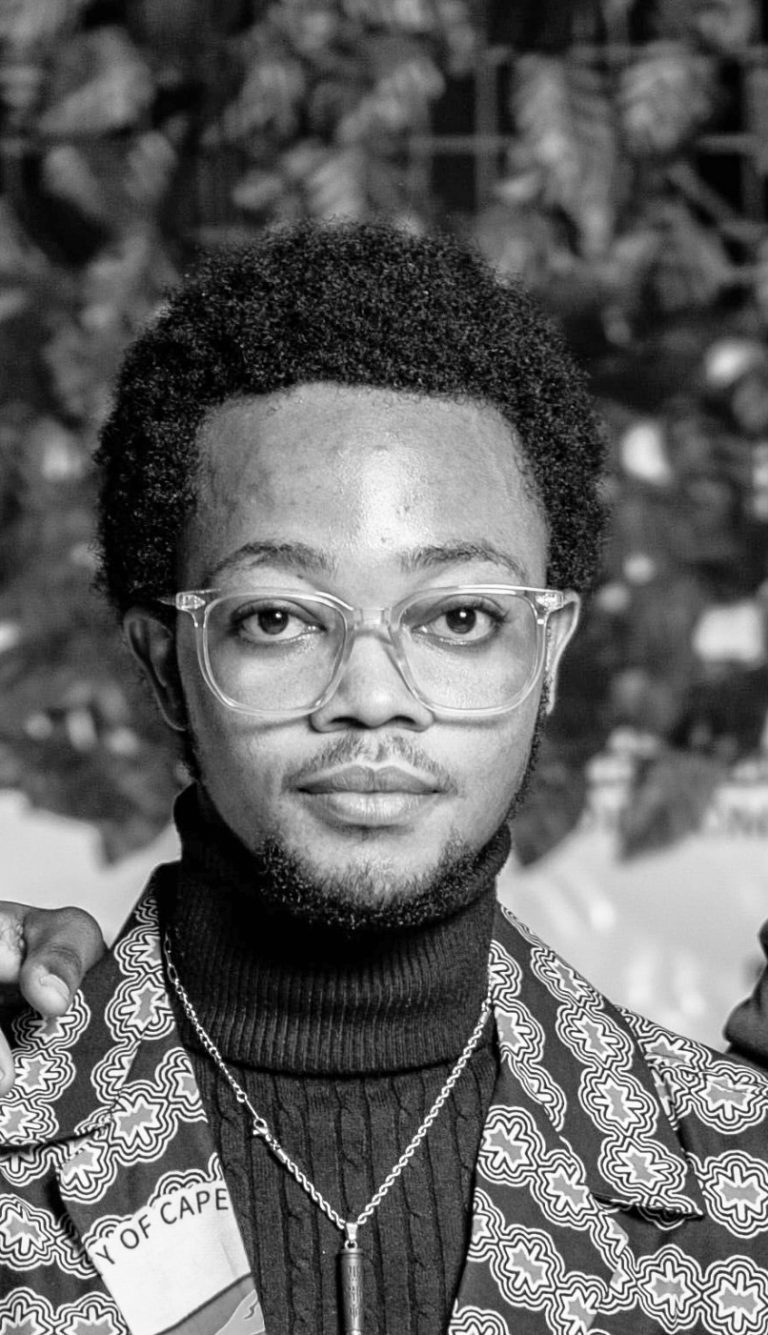
Scott Frost is a Ghanaian poet/writer and Biomedical Sciences student whose work explores identity, memory, love, death, and hope, drawing from Ghanaian oral traditions and lived experience. He was the first runner-up in the New Voices Poetry Contest 2025, and his work has been exhibited at the e-Ananse Library in Ghana and archived in the Museum of African Poetry. His poetry has appeared in Hummingbird Journal, Numen of Story, Creative Project Ghana, NENTA Journal, Jay Lit, African Writer, LIT eZINE Magazine, Drawn to the Light Press, Africa Poetry Magazine and Ta Adesa, with forthcoming work in Rowayat, Harbor Review, the International Anthology of Lost Souls Ltd, and elsewhere.
Isaiah Adepoju: Where does a poem start for you? And where does it end?
Scott Frost: Thank you for the invitation, Isaiah. I’m honoured to be part of this feature.
A poem starts for me with the tiniest occurrence of anything. They rarely come to me through grand gestures or elephant-sized ideas, but through mundane, sometimes slightly unreasonable situations: an insult a friend jokingly made to me, a funeral I witnessed, a sudden flash of emotional memory from my amygdala, or simply a line of words that keeps ringing in my mind like tinnitus. Anne Carson once said, “Start in the middle. It’s the only rule I have.” I find something appealing in that advice. Sometimes, the poem begins long after the experience itself, when a memory returns and asks to be looked at differently.
For instance, in “The Face of My Hometown Road,” I wrote about my village by giving it a face. Back in high school, a friend made a silly comment about my village, comparing the red dust on its roads to the colour of my skin. Years after school, the remark returned to me unexpectedly and made me think about the relationship between my face and the place I came from. That memory became a poem. Similarly, I drew on fragments of my mother’s memories of Ghana’s 1983 famine and the bushfires of that period in writing “‘83 Kɔm.”
There is a faint, blurry line between feeling that a poem is finished and sensing that there are still more ways to unravel it. Sometimes, revisiting a poem makes me want to add something. Other times, I find an image that stays with me and takes my mind with it. However, I do not always find the ‘right’ final image or fully express everything I want to say. But I am learning that a poem does not necessarily end when I have exhausted what I want to say about it. Sometimes, it ends when it has found its shape – when it stops resisting me enough for me to let it go.
Isaiah Adepoju: Twi/Akan words often enter your poems directly. Both in poems like “Before The Rain” grounded in locality, and a poem like “The First Thing They Take” that can be read independent of locality. How do you negotiate carrying Twi in your poetry alongside the English language? How do you conceive of their relationship, symbiotic or counterpoint, because glossary, added there for intelligibility in most of your poems and the ones above, can begin to mean excusing the reader of the need to garner interest and engage Twi/Akan on its own grounds?
Scott Frost: My decision about whether to translate a local word depends on the particular poem, the word itself, and sometimes the publication. There are pieces in which I feel a reader’s unfamiliarity with a word does more for the poem than an explanation would. In “Galamsey is a Quiet Word for Murder,” for instance, the Twi phrases are woven into the poem’s rhythm, atmosphere, cultural and historical references. Replacing them with English would change the texture of the poem and how its meaning unfolds. At other times, a glossary may help readers who do not speak Twi enter the work.
For me, the question is what a word is doing in the poem. Is it establishing a particular Ghanaian setting? Preserving a cultural meaning? Or simply expressing a thought in the language in which it came to me? Sometimes, I struggle to find an English equivalent that carries the same weight, as with “wanzam” in “Northern Girls Bleed.” If the blend of languages feels earned rather than forced, I do not second-guess it.
I do not think the relationship between Twi and English is always symbiotic in the sense that they must neatly complement each other. Sometimes, they enrich each other; at other times, the presence of one unsettles the other. I am interested in what happens in that space between them.
In “‘83 Kɔm,” I use the image of the “Rawlings chain” to bring together memories of drought, famine and bushfires with Ghana’s political history under J. J. Rawlings. Even a Twi speaker may need historical knowledge to fully grasp the reference. It reminds me that understanding a poem is not always a matter of knowing the language alone.
I believe poetry can communicate something meaningful even when a reader does not understand every word. We are all expected to meet a poem halfway. A glossary is sometimes useful, but I do not believe every unfamiliar word must be made immediately accessible.
Some words are better left unexplained, allowing readers to encounter their unfamiliarity and perhaps become curious enough to seek out what they do not know. I want to make room for readers without making the poem surrender everything to them.
Isaiah: In a time when the individual is often poetry’s subject of inquiry in its apprehension of the Human, your poems contemplate a different direction. They are grounded in the communal, even how one’s identity is framed and re-framed. “The Face of the Hometown Road” and “We Hunger”, read complementarily, do not just situate the self within the community. The poems also perform the work of inscribing communities and the people within them against erasure. What makes community an important aspect of your writing? Is there a burden – do you feel the need to carry and acknowledge nationality within aesthetics?
Scott: Community is like a sharpening stone for a farmer’s blade. To me, the individual and the community are never mutually exclusive; each shapes the other. I try, as much as possible, to represent society through the body and its experiences, because the personal is never entirely separate from the world that produces it.
“You walk out with a morning face and return with blush on your cheeks…” from “The Face of My Hometown Road” captures subtle aspects of my hometown that people might otherwise overlook. I give these experiences a face, turning them into words that a reader might encounter almost like a painting. There is a desire in that poem to make people pay attention to their surroundings and recognize the beauty in their imperfections.
With “We Hunger,” I am also interested in how an experience can belong to an individual and, at the same time, speak to something shared. In some small way, I want my writing to show the world the background I come from: loud, messy, chaotic, and fun.
I do not experience writing Ghanaian experiences as a burden or an obligation I must fulfil in every poem. It is part of my natural perspective. Still, I feel a kind of weight to write from home, because that is often where I feel truest to myself. I feel a responsibility towards the stories that find their way into my work. Some are too complex and fragile to be flattened for an outside audience. I want to preserve their textures without losing my Ghanaianness or reshaping them simply to fit the expectations through which others might read them. I want the work to travel, but I do not want it to have to abandon where it comes from to do so.
Isaiah: In “t(h) is Body”, the image of the woman changes against an encounter with an Other body. Suddenly the woman who balances labor and motherhood in “Before the Rain”, embodying resilience amid urban hardship, now “watches the way you walk as though it is a wound moving” praying for God to remove the body’s strange excess. This poem is an affirmation that this Other body exists. A confrontation with this new understanding of the human body can be consoled with, at least because of its human (re: instinctual) preoccupation with preserving its own identity. I am curious, however, as to what extent you think an accommodation of the Other – here I mean the craft and aesthetics of the Other, the life and culture of the Other, and so on – will not descend into chaos, that is, the continuous implosions of one’s identity. If prejudice is a bastion against descent into chaos, can we speak at all of it holding positive value?
Scott: I am interested in how society teaches us to read certain bodies as wrong before we have tried to understand the people inhabiting them. In some of my work, this emerges through the policing of masculinity and the shame attached to bodies and ways of being that fall outside accepted expectations. In “I Am Not Like You,” the speaker struggles to find himself in a world where masculinity is measured by strength, emotional detachment, and conformity. In “kwir/,” that rejection takes on a more explicitly queer dimension, where a person’s love is treated as foreign to the very place in which it grew.
In “t(h) is Body,” I was interested in a mother’s encounter with a body she perceives as different in a society that frowns upon difference. I wanted to explore how people can come to fear or reject what they do not understand, sometimes because they have inherited the same prejudices that have shaped their own understanding of the world. Portraying prejudice does not mean endorsing it; it is a way of examining how it becomes possible and how it is reproduced.
I think there is a distinction between preserving one’s identity and treating another person’s difference as a threat to it. The first does not necessarily require the second. We can be attached to our cultures, beliefs, and ways of life without requiring everyone else to conform to them. I do not think prejudice holds positive value simply because it preserves a familiar order. If that order depends on someone else’s exclusion, then what is being preserved may be less an identity than a fear of difference.
Making room for another person does not necessarily mean losing ourselves. It may instead require us to reconsider what we have been taught to fear and to recognize that another person’s humanity does not diminish our own. After all, who gets to decide that someone does not belong to the place that made them?
Isaiah: Which poet or poetry book have you learnt the most important craft lesson from? What is it? And how does it inform your own practice as a poet? Also, how has language shaped your poetic approach to subject matter that may have been impossible otherwise?
Scott: Koleka Putuma’s Collective Amnesia left an indelible mark on my mind and shaped the way I understand restraint. I have admired the collection since I first read it, particularly the way repetition can accumulate meaning and become something more than the reiteration of an idea. A poem can begin with something ordinary and gradually open into questions of memory, grief, home, ownership, and history without having to explain every connection it makes.
At the Cemetery is one of the poems from the collection that has stayed with me. It reminds me how much a poem can carry when the poet pays attention to physical details and trusts the reader to make connections. The collection has taught me to look at explanatory lines again and ask whether an image could do the work more powerfully. I am learning that a poem does not always become stronger by saying more. Sometimes, silence (like in her poem, Interview) or a single image can carry what an explanation might diminish.
I also revisit the work of Ghanaian writers and poets such as Kofi Anyidoho, Ama Ata Aidoo, and Kwesi Brew, whose craftsmanship continues to offer me things to learn from. Reading them reminds me that there are different ways of making language carry experience, memory, and the world around us.
Language, too, has shaped what I can approach in a poem. Sometimes, an experience arrives in Twi before I can find a way to express it in English. The original word carries associations, textures, and histories that a direct translation may not preserve. Rather than treating language as a container into which I pour an already formed thought, I have come to see it as part of how the thought takes shape. Moving between languages allows me to approach certain experiences from angles that might not otherwise be available to me.
Allow readers to encounter their unfamiliarity and perhaps become curious enough to seek out what they do not know. I want to make room for readers without making the poem surrender everything to them.
– Scott Frost
Bloodmeal
I woke up with a bird sitting in my throat.
I woke up heavy
with the particular weight
of a man who sent others
to their graves.
I woke up stone-cold,
statue blood shyly moving
through my veins,
my heart dull & thudding
like the closing of a coffin lid.
I woke angry,
my face fixed into stone,
puffy eyes & catarrh-choked nostrils
p-r-e-ten-d-i-n-g
it’s their first time
tasting the air.
Electricity in my brain.
My chest, a lake
My mouth, a playground with buried corpses
for all the names that never made it
out alive.
Our ancestors named me with letters,
applied attributes to me,
then laid me down gently
& killed me.
I woke in a bed full of sand,
my clothes stained with harvested blood.
I walked among graves: maggots, forgotten plywood crosses
At the fire,
our ancestors learned to walk upright,
sang death songs
with joyous shouts & chants
Then fed the fire
my skin.
I Went to the Dead
I am in contact with the ones who came before us.
At the head of a flock I have led
to this pass.
Impatient sheep,
what’s the big rush?
Let me breathe the smell of our Dead,
gather and speak again their living voices.
I came with bulldozers,
villagers of Odoben-Brakwa,
to trample the putrid naked bodies and souls
in blatant violation.
There will remain no names to link with battered bones,
so here I crouch and nock my venomed arrow
to pierce deaf eardrums waxed by the unmanning power of pride.
It is necessary for you to listen.
Go tell the gossips not to stab my confessions
with eyes that pretend to know everything.
These feet have kissed the sands of many shores.
For I went to the land not for the living,
and it is imperative we seek loans
to go beg the Dead.
Even if it costs each of us a meal a day,
or the rightful head successor to every clan,
for their anger is louder
than empty barrels.
Eno Mansa’s voice three times touched me,
urged me to ask how they survived
and why it still hurts to inherit a land you love
but must constantly fight to save.
To plead on your behalf,
even if I am to sacrifice my testicles.
To them, the good children
are those who ask no questions.
Their delicacy to manners
is like the schoolboy
who feigns affection.
The men who brought purgatory to this land
If they look for bloody battle, they shall have it.

