
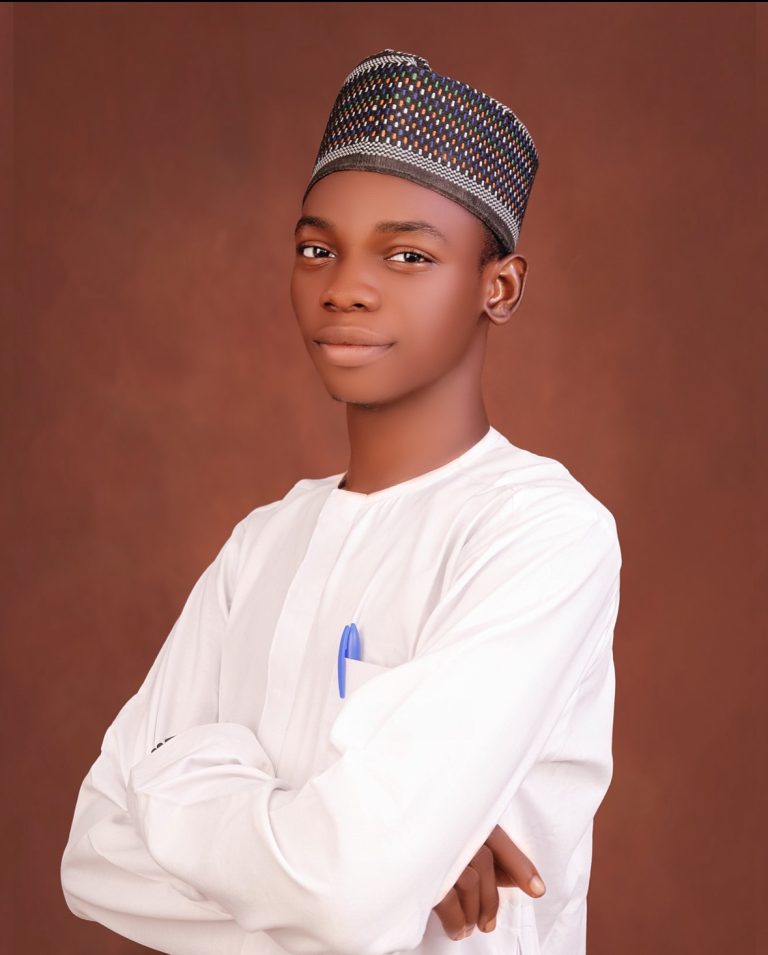
Abdulrazaq Salihu, TPC I, is a Nigerian Writer and Performance Poet. A member of the hilltop creative arts foundation, he has Received Residencies from IWE Nigeria, Frances Thompson Writers studio and is a 2025 Fellow at the LOATAD Black Atlantis. He won the Masks Poetry Award, LAP performance poetry prize, SOD, BKPW And poetry archive contest. He’s the author of “Constellations” and “Hiccups” and has his chapbook “Quantum entanglements with notes on loss” forthcoming with Sundress Publication 2025. He has his works published/forthcoming with Palette Poetry, Frontier Poetry, Uncanny, Bacopa Mag, Strange Horizons, Stachion, Consequence Forum, SofloPojo, Bracken magazine, Poetry Quarterly and elsewhere, He tweets @Arazaqsalihu and instagram: abdulrazaq._salihu
Isaiah Adepoju: Hi Abdulrazaq, it is good to have you as our featured poet for the month. I have been thinking a lot about poetry as a “serious” art and would love to hear your opinion on this. Who is a serious poet? And what is serious poetry?
Abdulrazaq Salihu: To me, a serious poet is not someone who writes in a particular style or follows a prescribed tradition. It is basically someone who shows up to the work with truth, devotion, and integrity. I personally believe that if seriousness must be measured at all, then it should be measured by the ability to be a poet every day of your life, to stay committed, to be present, and to be honest with your art.
Every form of writing is serious if the poet believes deeply in the gospel of their own truth. For one person to see the light in a poem means a thousand others will eventually see that same light. That is the mysterious, sacred ripple of art. As Rainer Maria Rilke wrote, “Go into yourself. Find out the reason that commands you to write… this above all, ask yourself in the stillest hour of your night: must I write?”
Serious poetry, then, is any writing that emerges from this inner must; this devotion to living truthfully on and off the page.
Isaiah Adepoju: It’s a predominant concern to writers how they capture the places they are from in their work. So, my question to you is, what does space or setting mean to you as a writer? Africa/Nigeria generally, and Sarkin Pawa specifically.
Abdulrazaq Salihu: Space, to me, is both an exile and a homecoming. Even though writers have the freedom to write about anything and anywhere, I personally feel I owe my spaces, my people, and my communities far more than I owe myself. Like Ubuntu, I am because they are, because we are.
Africa, Nigeria, and especially Sarkin Pawa are not merely places, they are the architecture of my becoming. They shape my imagination, my politics, my metaphors, my grief, and my joy. I am a product of these spaces and of what happens within them, and they will always hold relevance in my writing because my voice exists inside their own chaos and calm.
Setting, then, is not backdrop, it is perhaps a kind of lineage. It is memory insisting on being written.
Isaiah Adepoju: Are you of the opinion that cultural and literary obligations matter? As a young poet, how do you balance the need to articulate your feelings with these obligations?
Abdulrazaq Salihu: Yes, obligation exists, but I believe the first and most sacred duty of any writer is to be true to the art and to the artist. Writing happens in phases. In the beginning, poetry is primarily a vessel for expression, this raw articulation of feeling is often the most important and the most honest work a young poet can do. And it must be owned completely. But as time moves, the universe begins to assign new tasks. You might gradually lose the urgency of personal expression and begin to inherit the responsibility of writing about political realities, social structures, or cultural memory. These shifts happen naturally, and the writer must allow them; must hold on with honesty and let go when it is time to.
James Baldwin said, “The role of the artist is exactly the same as the role of the lover: if I love you, I must make you conscious of the things you do not see.” So yes, obligation matters. But it must come from an organic evolution of the self, not from pressure, but from purpose.
Isaiah: I noticed a trope of compassion and vulnerability in your poetry. Are these where your poetic obsessions lie or is it only a place to begin from as a young writer who is still discovering their voice?
Abdulrazaq: No. I will write about these themes today and forever. As poets, we experience the world at a frequency that is not necessarily ordinary for others. We feel things deeply, urgently, and sometimes painfully. Yet in all these shifting themes and evolving phases, there is always one constant.
For me, that constant is empathy and vulnerability. Even when I write about other subjects: politics, history, nationhood, conflict, there is always a small pinch of compassion hidden somewhere. These themes are not youthful exploration; they are spiritual anchors. They are how I understand the world and how the world understands me.
I believe I will write about them even in Jannah, in shaa Allah.
As Audre Lorde said, “Caring for myself is not self-indulgence, it is self-preservation, and that is an act of political warfare.” And as Ocean Vuong reminds us, “What is a country but a life sentence?” This only proves that tenderness is often our greatest rebellion.
Isaiah: Artists and non-artists alike understand the importance of solitude as a necessity for the creation of art. However, art is also a communal practice. What role does your community play for you as an artist and how do you navigate the balance between your communal obligations and the solitude needed for art?
Abdulrazaq: What bothers my community bothers me, what bothers me bothers my community because I am a part of it.
Community, for me, is both a responsibility and a refuge. It shapes the ways I see the world, the stories I hold, the silences I protect, and the languages I inherit. A poet does not stand alone. We are shaped by the collective breath of the people who raised us, loved us, challenged us, and made us.
But solitude is equally necessary. It is the quiet room where the noise of the world settles long enough for the poem to speak. Living in a community does not mean losing yourself; it means learning when to step back, when to engage, and when to return with something honest to offer.
Toni Morrison once said, “The function of freedom is to free someone else.”
Community gives us purpose. Solitude gives us the clarity to fulfill that purpose.
Africa, Nigeria, and especially Sarkin Pawa are not merely places, they are the architecture of my becoming. They shape my imagination, my politics, my metaphors, my grief, and my joy. I am a product of these spaces.
– Abdulrazaq Salihu
An attempt at retelling how the world ends
This is how the world ends.
سوف ينتهي العالم في هدوء وفوضى
The universal sea slowly seeps
Into the rusty spores of the earth.
سوف ينتهي العالم في هدوء وفوضى
When I see you, my beloved,
The earth angers in smoke and blurs vision.
سوف ينتهي العالم في هدوء وفوضى
I know nothing about dajjal beyond the
Chaos he’d bring forth, what do I know
About Dabbatul-Ard? What fear rises
The sun from the west? Sunsets for a mandarin
Who do I tell my black skin is my own?
Who do I tell, when I watch my Sarkin pawa
People fold into smoke; I’m no more than fire,
Lover, when I watch the angel of death
Pull this: significant amount of light shun well—
From your feet, I cannot stop them…
Because سوف ينتهي العالم في هدوء وفوضى
Lover, when you slowly succumb to lifelessness
I battle my own breaths to un-live. Lover,
When you finally die. I remember my father
How much a wreckage the earth made him
How insignificant his pain looked after his death,
I remember the little fat protruding from his left
Rib; the exquisiteness of a knife stab. lover,
when we cover you in cottons,
I remember my father’s skin filthing with dry blood.
And because سوف ينتهي العالم في هدوء وفوضى
Lover, when I cry, when I mourn you at the end
Of the world, I mourn my father’s suffering
I mourn my people’s loss, I mourn the little
Mole of loneliness I never rid off my mother‘s skin.
Lover, in the end of the world, there’s no loss
Only regrets, only recaps of lights shun well.
The Qibla in this world points upwards.
Buried beneath us, the qiblah
of dead things is the sky.
We proclaim how happy they are.
Because now they know no suffering.
Gravity there, is a ripple effect in the rift
Of the now raging continuum.
The folklores, unapologetic in their passionate
Flow through the vineyards, we hold hands
In the astral projection of reemergence,
The dead, now ghosts in the flickering touch
Of life, are free of the curse of loneliness —
Its fangs broken from the spine of their bones,
The dead, now reefs in the desert of God
Have no business with the aesthetics of a
Scab on a skin, its borders shrinking back
Into a sweat pore, God is really the absence
Of too much rationality. A light when you close
Your eyes and walk into your head: headquarters
Of all the things buried in a world just 4 stamps below us.
Buried beneath us, the dead look up and marvel at our
Struggles, laugh at our foolishness, curse at our cowardice,
Until the universe tears open a doorway, we look down,
We look at how miserable the dead are, how miserable
Things buried will always be—
The Upside Down.
Stranger things.
We lost the Will to live when time,
Ripped by the mistakes of those who were,
Before us damned to suffering opened their
Hearts to the endless possibilities of being here
And there in the same instances, for instance,
Instead of a wall, almost cracked open by nostalgia,
Walls here are built on memories of fear—
My mother and I sit in the comfort of reality,
Our love for joy thickens into vines, cold and
Untouched by the miracles of the sun.
I do not know anything about faith, really,
But all my life I have always believed in the existence
Of a parallel universe where everything I am, here,
Is the exact opposite in all its might and glory and life.
My mother opens her mouth to succumb to a smile,
In the upside down, her teeth is fuming with blood,
Eyes whitened by the slow vanishing of purpose.
Time here, is a broken descrambler, all the clocks, still
The way gravity holds its weight down to earth.
I do not like the way things are here, I do not understand how
I’m a witness of how things built of beauty reek like forgotten
Memories in the mouth of a time loop, repeat the death
Repeat the aching, repeat the entire process of suffering
Everything here is a mirror image of how it’d be when its
Mouth is filled with suffering. I dread my vulnerabilities,
How this place is covered by the anguish of buried trauma,
Boys whose names spark light, now wilting like smoke.
My mother calls me home, my mother opens her mouth
And calls me son, I want to go home, I want to hold
The tenderness of my mothers palm but I’m my own enemy,
I’m Vecna, banished by myself into this exquisite
continuum of Endless Darkness

